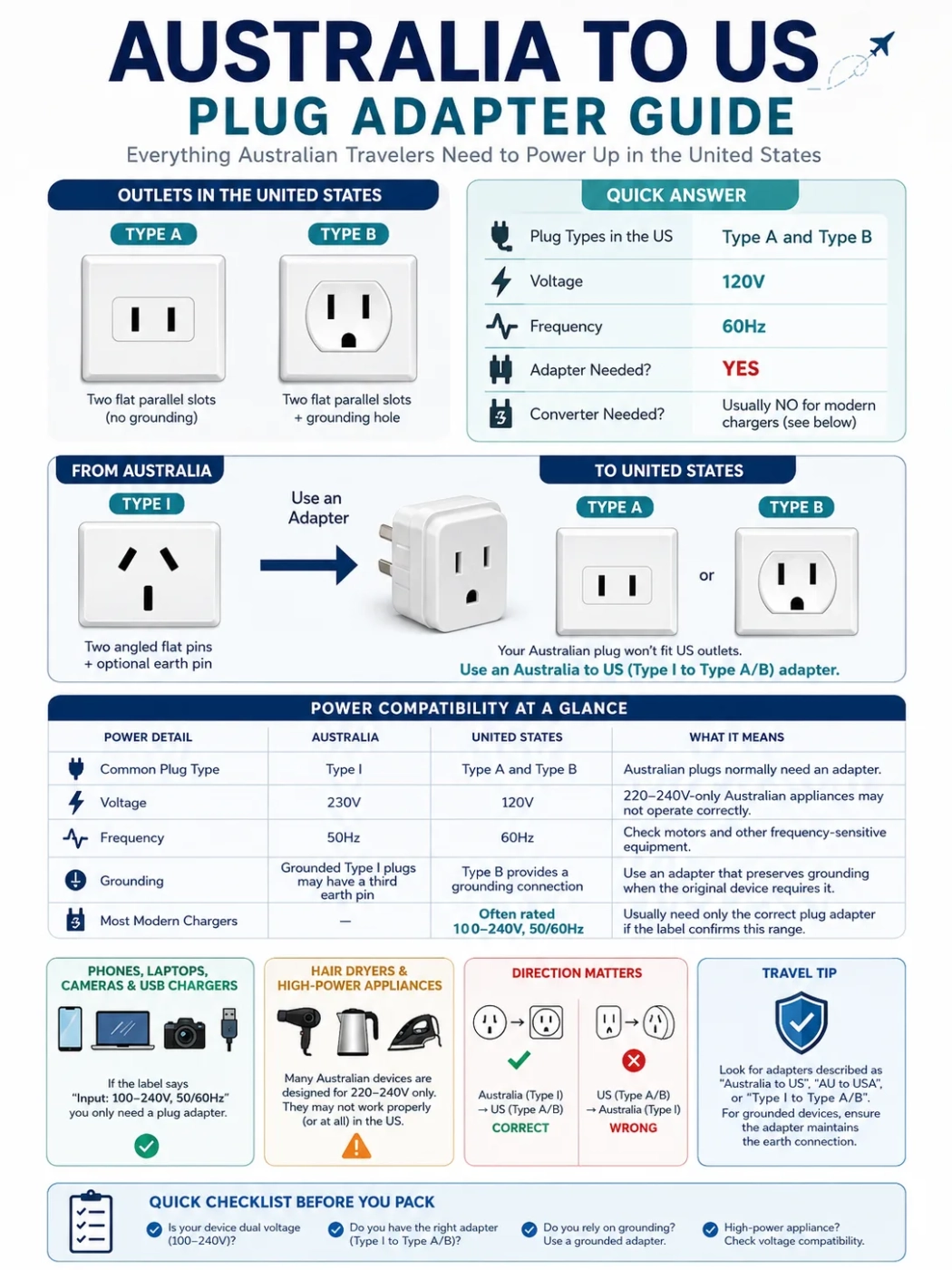
Australian Type I plugs do not fit standard US Type A or Type B outlets, so travelers from Australia normally need an Australia-to-US plug adapter. The other issue is voltage: Australia uses about 230V at 50Hz, while standard US wall outlets supply about 120V at 60Hz. Many phone, laptop, camera, and USB chargers marked Input: 100–240V, 50/60Hz can use US power with only a plug adapter. Australian appliances designed only for 220–240V need more checking.
| Power Detail | Australia | United States | What It Means |
|---|---|---|---|
| Common plug type | Type I | Type A and Type B | Australian plugs normally need an adapter. |
| Voltage | 230V | 120V | 220–240V-only Australian appliances may not operate correctly. |
| Frequency | 50Hz | 60Hz | Check motors and other frequency-sensitive equipment. |
| Grounding | Grounded Type I plugs may have a third earth pin | Type B provides a grounding connection | Use an adapter that preserves grounding when the original device requires it. |
| Most modern chargers | Often rated 100–240V, 50/60Hz | Usually need only the correct plug adapter if the label confirms this range. | |
Australia-to-US Plug Compatibility
Australia and the United States use different physical plug systems. Australian Type I plugs have two angled flat pins, with a third earth pin on grounded versions. US Type A outlets use two parallel flat slots, while Type B adds a round grounding opening.
A Type I plug should not be forced into a US socket even though both systems use flat metal contacts. The pin angles and outlet layouts are different. Look for an adapter described as Australia to US, AU to USA, or Type I to Type A/B.
Make Sure the Adapter Is Facing the Right Direction
Travel adapters are directional. An adapter made for a US traveler visiting Australia is the reverse of what an Australian traveler needs in the United States.
- Correct direction: Australian Type I device plug → US Type A/B outlet
- Wrong direction: US Type A/B device plug → Australian Type I outlet
The destination side of the adapter needs to fit a US outlet. For a grounded Australian appliance, a Type B-compatible adapter that maintains the earth connection is the more appropriate configuration.
The 230V to 120V Difference Matters More Than the Plug Shape
The physical adapter is only one part of the problem. Australia operates on a higher mains voltage than the United States. An Australian appliance designed only for 220–240V is being moved to a lower-voltage 120V system.
A plug adapter does not convert voltage. It changes the mechanical connection between the Australian plug and the US outlet. It does not turn 120V electricity into 230V.
This direction of travel is different from taking a 120V appliance into a 230V country. A 230V-only Australian appliance connected to 120V is not normally being exposed to excessive voltage; instead, it may receive too little voltage to operate as intended. Depending on the appliance, it may fail to start, heat weakly, run incorrectly, or not work at all.
Why Lower Voltage Can Be a Problem
A simple heating element designed for 230V can deliver far less heat when supplied with 120V. For an ideal resistive load with unchanged resistance, power follows the relationship V²/R. Under that simplified assumption, operating a 230V heating element at 120V would provide only about 27% of its rated power.
Real appliances can include electronic controls, motors, thermostats, and other components, so this calculation should not be used to predict the behavior of every device. It does show why an Australian kettle, iron, or single-voltage hair dryer should not be expected to perform normally in the US merely because an adapter makes the plug fit.
Check the Device Label Before Packing It
The most useful information is normally printed on the charger, power brick, appliance body, or rating plate. Look for a line beginning with Input, AC Input, or a voltage range.
| Device Label | US Compatibility | Likely Requirement |
|---|---|---|
| Input: 100–240V, 50/60Hz | Designed for both Australian and US mains ranges | Usually a Type I-to-A/B plug adapter only |
| Input: 110–240V, 50/60Hz | 120V US supply is within the stated range | Usually a plug adapter only |
| Input: 220–240V, 50/60Hz | US 120V is below the stated input range | Adapter alone is not enough to establish compatibility |
| 230V, 50Hz only | Both voltage and frequency differ | Check the appliance specifications before use |
| No readable voltage information | Unknown | Do not assume compatibility |
What “Input: 100–240V” Means
If a charger says Input: 100–240V, its power supply is designed to accept a wide voltage range that covers both Australian and US mains power. If it also says 50/60Hz, it is designed for either common mains frequency.
That is why many modern electronics can move between Australia and the United States without a voltage converter. The charger handles the electrical difference; the travel adapter handles the plug shape.
Check the AC charger rather than assuming compatibility from the device itself. A USB-C cable, Lightning cable, or USB cable does not determine whether mains voltage is compatible. The AC power supply connected to the wall does.
Adapter Only or Step-Up Voltage Converter?
If an appliance is designed only for 220–240V, a normal travel adapter cannot supply its required voltage from a standard 120V US outlet. Where voltage conversion is appropriate, the electrical direction would be 120V up to approximately 220–240V.
| Accessory | What It Does | Australia-to-US Use |
|---|---|---|
| Type I to Type A/B adapter | Changes plug shape | Needed for most Australian plugs |
| Grounded Type I to Type B adapter | Changes plug shape while providing a grounding path when properly designed | Suitable direction for Australian equipment that requires grounding |
| Step-up voltage converter | Raises a lower supply voltage to a higher output voltage | May be relevant for certain 220–240V-only devices |
| Step-down voltage converter | Reduces higher voltage to a lower voltage | Normally the opposite conversion direction for this trip |
A converter also needs an adequate wattage rating for the appliance. High-power heating devices and motor-driven equipment can require far more capacity than a small travel converter is intended to provide. Do not use a converter or adapter beyond its stated electrical rating.
Which Australian Devices Usually Travel Easily?
Modern electronic chargers are often the simplest devices to take to the US because many use switch-mode power supplies covering both voltage systems. Appliances that directly create heat or run larger motors deserve more attention.
| Device | Plug Adapter? | Voltage Concern? | What to Check |
|---|---|---|---|
| Phone charger | Usually yes | Usually low if dual voltage | Look for 100–240V, 50/60Hz |
| USB-C charger | Usually yes | Usually low if dual voltage | Read the AC input rating |
| Laptop charger | Usually yes | Usually low if dual voltage | Check the power brick |
| Camera battery charger | Usually yes | Depends on charger | Check its input range |
| Electric toothbrush | Usually yes | Varies by charging base | Check the base or supplied power adapter |
| Electric shaver | Usually yes | Varies | Check voltage and frequency |
| CPAP machine | Usually yes | Model-dependent | Check the power supply and manufacturer instructions |
| Hair straightener | Yes | Depends on whether it is dual voltage | Check the voltage range or selector |
| Curling iron | Yes | Depends on whether it is dual voltage | Check the voltage rating |
| Hair dryer | Yes | High if 220–240V only | Voltage, wattage, and dual-voltage setting |
| Kettle | Yes | High | Voltage and wattage |
| Clothes iron | Yes | High | Voltage and wattage |
Phones, Tablets, Cameras, and Laptops
A phone or laptop bought in Australia does not automatically require a voltage converter in the United States. The deciding factor is the charger input specification.
A charger marked 100–240V, 50/60Hz can normally accept US 120V/60Hz power directly. In that situation, the Australian traveler mainly needs a physical Type I-to-Type A/B adapter.
The same check applies to camera chargers, tablet chargers, gaming laptop power supplies, and multi-port USB chargers. Do not assume compatibility solely because the device is electronic; verify the printed input range.
Hair Dryers, Curling Irons, Straighteners, Kettles, and Irons
Heat-producing appliances deserve a separate check because many draw much more power than phone or laptop chargers. Some travel hair tools are dual voltage, while other Australian models are designed only for approximately 220–240V.
If a hair dryer or styling tool has a manual voltage selector, make sure its supported settings include the US voltage range and follow the device instructions before connecting it. If its label states only 220–240V, a plug adapter by itself does not make it a 120V appliance.
A high-wattage step-up converter can also be bulky and must be rated for the appliance being connected. For items such as kettles, full-size hair dryers, and clothes irons, using a device designed for the local US power system is often simpler than arranging high-power voltage conversion.
50Hz in Australia vs 60Hz in the US
Australia operates at 50Hz, while the US operates at 60Hz. Many electronic power supplies accept both frequencies and state 50/60Hz on their labels.
Frequency deserves more attention when a device contains an AC motor, mechanical timing system, pump, or other component whose operation can depend on mains frequency. An Australian device marked only 50Hz should not automatically be treated as 60Hz-compatible.
This can matter for some older appliances, motor-driven devices, pumps, specialty equipment, and medical equipment. Check the rating label and operating instructions rather than relying only on the plug adapter.
Grounded Australian Plugs Need the Right US Connection
A grounded Australian Type I plug uses an earth connection in addition to the two current-carrying pins. In the United States, Type B is the common grounded outlet format.
If the original appliance depends on protective grounding, choose an adapter designed to maintain that grounding connection through a suitable Type B outlet. An adapter that terminates in only two Type A pins cannot create a protective earth connection.
Physical fit and grounding are separate checks. An adapter can make a plug fit while failing to provide the grounding arrangement intended for the appliance.
Using an Australian Power Board in the US
Travelers sometimes consider connecting an Australian power board to one US adapter so several Australian plugs can be used from a single outlet. This arrangement requires more than checking whether the first plug fits.
The power board itself must have appropriate electrical ratings, the travel adapter must support the intended load, grounding must be preserved where required, and every device connected to the board must be individually compatible with US 120V/60Hz power.
Connecting a power board after a plug adapter does not convert voltage for the devices on that board. A 230V-only appliance remains a 230V-only appliance.
For several phones, tablets, watches, and laptops, a multi-port charger specifically rated for 100–240V, 50/60Hz can often reduce the number of mains adapters and outlets needed.
CPAP Machines and Other Medical Equipment
Many modern medical-device power supplies can operate over a wide input range, but compatibility should never be assumed from the device category alone.
For a CPAP machine or other powered medical device, check:
- the input voltage printed on the power supply;
- whether 60Hz operation is supported;
- grounding requirements;
- the electrical rating of any humidifier or integrated accessory;
- the manufacturer’s operating instructions for international power use.
If the power supply states 100–240V, 50/60Hz, a plug adapter may be the only mains accessory required. If the rating does not clearly cover US power, verify the device requirements before travel rather than assuming that a generic voltage converter is suitable.
Avoid These Australia-to-US Adapter Mistakes
Buying the Adapter in the Wrong Direction
“US to Australia” and “Australia to US” describe opposite products. An Australian traveler needs the adapter whose input accepts the Australian Type I plug and whose destination pins fit a US Type A or Type B outlet.
Assuming Lower Voltage Means Automatic Compatibility
US voltage is lower than Australian voltage, but that does not mean every Australian appliance will work correctly. A device designed for 230V may receive insufficient voltage on a 120V outlet.
Buying a Step-Down Converter
Step-down conversion reduces voltage. That is normally the wrong direction when the aim is to operate a 220–240V-only Australian appliance from a 120V US outlet. If conversion is appropriate for the device, the required direction is generally step-up.
Ignoring Grounding
Using a two-pin adapter for an appliance that was designed with a protective earth connection can remove the intended grounding path. Grounded Australian equipment should use a suitable grounded adapter and Type B connection.
Checking the Device but Not Its Charger
The mains voltage rating is often printed on the charger or power brick rather than prominently on the phone, laptop, camera, or other battery-powered device.
Assuming “Universal Adapter” Means “Universal Voltage”
A universal travel adapter may provide several plug configurations, but it normally does not change the incoming mains voltage. Always check the device’s voltage range independently.
What to Pack for the US
For a traveler carrying mostly modern electronics, a simple setup can be enough:
- a Type I-to-Type A/B travel adapter;
- a grounded version if any device requires an earth connection;
- chargers confirmed to support 100–240V, 50/60Hz;
- the normal USB-C, USB, or device charging cables.
If several devices charge by USB, one multi-port dual-voltage charger can reduce the number of Australian AC plugs that need separate adapters.
Before packing hair tools, kettles, irons, motor-driven appliances, or other high-power equipment, check each rating label individually. Do not choose a voltage converter until the appliance voltage, frequency, wattage, and grounding requirements are known.
Some hotel rooms may provide USB charging ports or additional charging connections, but these should be treated as conveniences rather than the basis of the travel power plan. Do not assume that a universal-looking hotel socket changes the voltage.
Australia-to-US Device Decision Table
| Device Situation | Plug Adapter | Converter | Decision |
|---|---|---|---|
| 100–240V, 50/60Hz | Yes | Usually no | Normally suitable for US power with the correct adapter. |
| 100–240V with grounded Type I plug | Grounded adapter | Usually no | Use a Type B connection that preserves grounding. |
| 220–240V, 50/60Hz only | Yes | May require step-up conversion | Do not treat an adapter alone as sufficient. |
| 230V, 50Hz only | Yes | Voltage conversion alone may not solve frequency compatibility | Check device specifications. |
| Dual-voltage hair tool | Yes | Usually no when correctly configured for 120V | Check its voltage range or selector before use. |
| High-power 230V-only appliance | Yes | Potentially large step-up converter | A US-rated alternative may be more practical. |
| Unknown or unreadable rating | Possibly | Unknown | Do not guess from the plug shape. |
FAQ
Do Australian plugs fit US outlets?
No. Australian Type I plugs do not directly fit standard US Type A or Type B outlets. You normally need an Australia-to-US plug adapter.
Do I need a voltage converter from Australia to the US?
Not if your device is rated for US voltage. A charger marked Input: 100–240V, 50/60Hz normally needs only a plug adapter. Australian devices rated only for 220–240V require additional checking and may need appropriate step-up voltage conversion.
Will my Australian phone charger work in America?
Usually, if the charger’s AC input label includes 120V. Many modern phone chargers say 100–240V, 50/60Hz. You would then normally need only a Type I-to-Type A/B adapter.
Can I use an Australian hair dryer in the US?
Only if its voltage specifications support US power or it is used with an appropriate conversion setup. A 220–240V-only hair dryer should not be assumed to work normally from 120V simply because a plug adapter fits.
Is US electricity 110V or 120V?
For travel-device planning, standard US household wall outlets are generally treated as 120V, 60Hz. The term “110V” is still commonly used informally, but check equipment against its actual stated input range.
Can I use an Australian power board with a US adapter?
Do not assume that one adapter makes everything connected to the power board compatible. The board, adapter, grounding arrangement, total load, and every connected device must be suitable for the US supply.