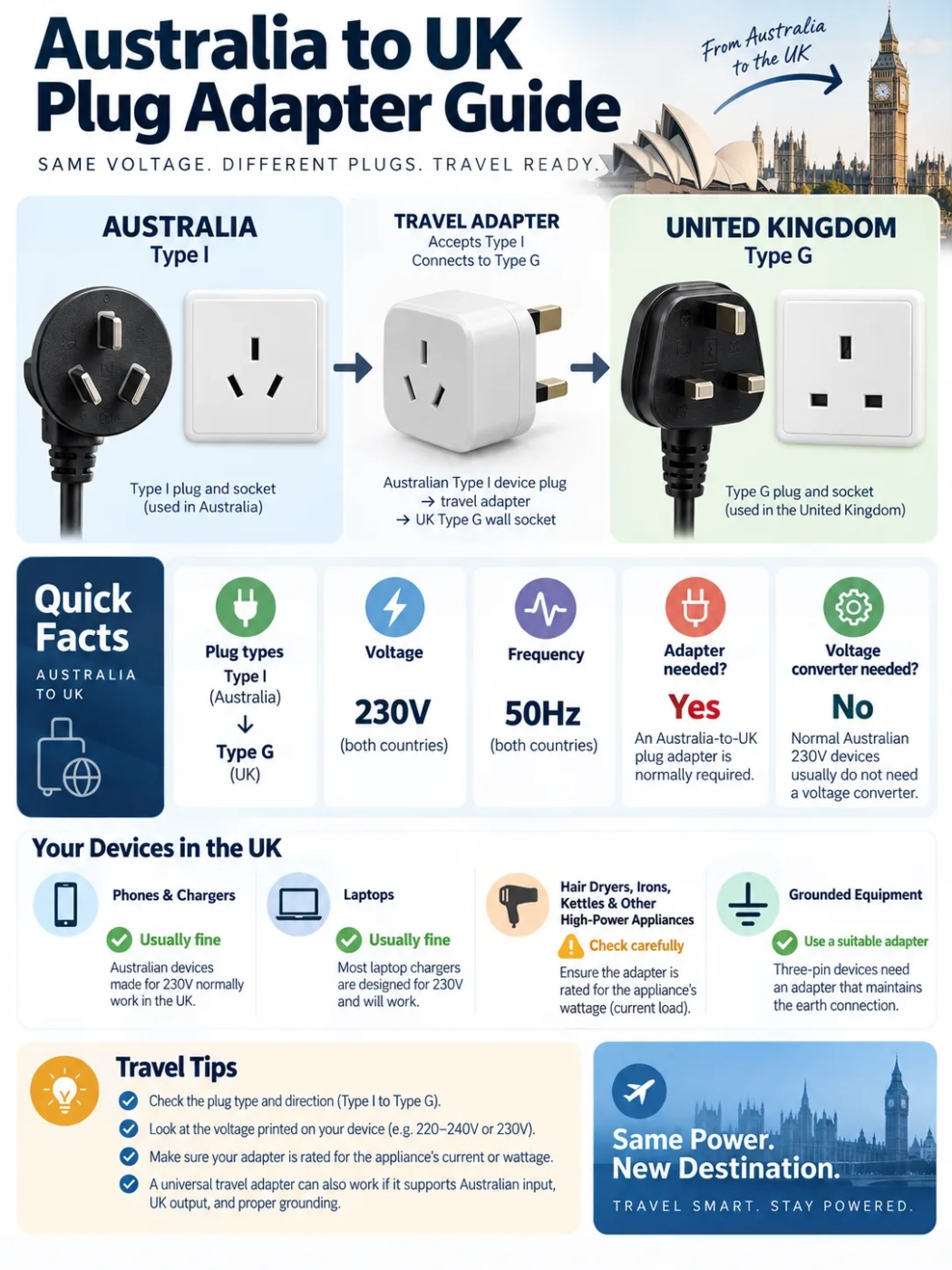
Australian plugs do not fit standard UK wall sockets. Australia mainly uses Type I plugs, while the United Kingdom uses Type G, so an Australia-to-UK plug adapter is normally needed. The electrical supply itself is much less complicated: both countries use a nominal 230V supply at 50Hz, which means normal Australian-market devices usually do not need a voltage converter.
The main checks are the direction of the adapter, the voltage printed on the device, grounding, and the adapter’s maximum current or wattage. This becomes especially important with hair dryers, irons, kettles, and other high-power appliances.
| Power detail | Australia | United Kingdom | What it means |
|---|---|---|---|
| Common plug/socket type | Type I | Type G | Plug adapter normally required |
| Nominal voltage | 230V | 230V | Normal Australian 230V devices usually do not need voltage conversion |
| Frequency | 50Hz | 50Hz | No normal Australia-to-UK frequency difference |
| Grounded plug design | Three-pin Type I available | Three-pin Type G | Grounded equipment needs an adapter that maintains the earth connection |
| Main high-power concern | Device wattage | Adapter current/watt rating | The adapter must be rated for the appliance load |
Type I to Type G: The Adapter Direction You Need
An Australian device with a fixed mains plug needs an adapter that accepts an Australian Type I plug and connects to a UK Type G socket. Product descriptions can be confusing because some adapters are advertised by destination while others are described by the plug types they accept.
The electrical path should be:
Australian Type I device plug → travel adapter → UK Type G wall socket
A product designed for the opposite direction — UK Type G equipment into an Australian Type I socket — is not the adapter needed for this trip. A universal travel adapter can also work if its Australian input, UK output, current rating, and grounding arrangement are suitable.
Why the Plug Changes but the Voltage Usually Does Not
Australia and the United Kingdom both use a nominal mains supply of 230V at 50Hz. For equipment made for normal Australian household power, this removes the voltage mismatch that travelers face on routes between 120V and 230V countries.
An Australian appliance marked 220–240V, 230V, 230–240V, or a similar range that includes 230V will normally be suitable for the UK supply from a voltage perspective. The plug still needs to fit the socket.
A plug adapter does not convert voltage. It only creates the physical connection between one plug system and another.
What “Input: 100–240V” Means
Phone chargers, laptop power supplies, camera chargers, USB chargers, and other electronic power supplies often show a label similar to:
Input: 100–240V ~ 50/60Hz
A power supply with that range is designed to accept mains voltage anywhere within the stated range and either 50Hz or 60Hz. Because UK power is 230V/50Hz, such a charger normally needs only the correct Type G connection.
The label may be on the charger rather than on the phone, laptop, camera, or other device because the charger is the part connected directly to mains power.
Do Not Judge a Device Only by Where You Are Traveling From
A device carried from Australia is not automatically a 230V Australian-market appliance. Someone may own equipment originally purchased in the United States, Japan, Canada, or another country with a different electrical system.
For example, a device marked only 120V should not be treated as UK-compatible simply because it has been used or stored in Australia. The device label is more reliable than the departure country.
Australian Devices in the UK
| Device | Plug adapter? | Voltage converter? | What to check |
|---|---|---|---|
| Phone charger | Usually yes with a fixed Australian plug | Normally no | Look for Input: 100–240V |
| Laptop charger | Usually yes, or use a compatible UK mains lead | Normally no | Input voltage, grounding, detachable cable type |
| Tablet or USB charger | Usually yes | Normally no | Input rating on the charger |
| Camera battery charger | Usually yes | Normally no for wide-range chargers | Input voltage and frequency |
| Hair straightener | Usually yes | Normally no for a 220–240V model | Voltage and adapter watt/current limit |
| Hair dryer | Usually yes | Normally no for a 220–240V Australian model | High wattage and adapter current rating |
| Electric shaver | Depends on charger and outlet used | Usually no if rated for 230V | Charger input and bathroom outlet type |
| Electric toothbrush charger | Depends on the charging base | Usually no if rated for 230V | Input rating and socket type available |
| CPAP power supply | Often yes | Depends on the exact power supply | Manufacturer instructions, input range, grounding, power supply rating |
Phones, Laptops, Cameras, and USB Devices
Modern electronic chargers are generally the easiest category on this route. If the charger states Input: 100–240V, 50/60Hz, UK mains power falls within its designed input range.
In that situation, voltage conversion is not required. A Type I to Type G adapter is enough if the charger has a fixed Australian plug.
USB-C does not by itself solve wall-plug compatibility. A USB-C cable may connect the charger to the phone or laptop, while the charger’s mains side still has an Australian Type I plug.
Hair Dryers, Straighteners, Curling Irons, Kettles, and Irons
Heat-producing appliances need more attention because they can draw far more current than a phone or laptop charger. An Australian hair dryer marked 220–240V may be voltage-compatible with the UK, but that does not mean every travel adapter can carry its load.
Check both the appliance rating and the maximum AMPS or WATTS printed on the travel adapter before using a high-power appliance.
The same rule applies to curling irons, hair straighteners, travel kettles, clothes irons, and other heating appliances. A voltage match and a physical plug fit are only two parts of the decision.
The Adapter Can Be the Limiting Part With High-Wattage Appliances
Current can be estimated from appliance power on a 230V supply with:
Current in amps ≈ watts ÷ 230
| Appliance power | Approximate current | Typical context |
|---|---|---|
| 65W | 0.28A | Small laptop charger |
| 100W | 0.43A | Higher-power USB-C charger |
| 1,200W | 5.2A | Heating appliance |
| 1,800W | 7.8A | High-power personal appliance |
| 2,000W | 8.7A | Hair dryer example |
| 2,400W | 10.4A | Very high-power appliance |
A 2,000W appliance draws roughly 8.7A at 230V. It therefore exceeds the stated limit of an adapter rated for only 6A. A 2,400W appliance draws about 10.4A, so it is also above a 10A adapter’s stated current limit.
The rating printed on the travel adapter is the limit to follow. The presence of a high-capacity wall circuit does not raise the rating of a lower-capacity adapter.
The calculation is only an electrical load check. It does not confirm product quality, earth continuity, fuse arrangement, condition, or suitability for a particular appliance.
Three-Pin Australian Plugs Need Proper Earth Continuity
A three-pin Australian Type I plug includes an earth connection. If the connected appliance relies on protective earthing, the travel adapter should carry that connection through to the UK Type G system.
An adapter can physically accept three pins without necessarily providing a functional earth path. Three pins fitting into the adapter is not proof that the appliance remains grounded.
This matters for grounded equipment, some laptop power supplies, appliances with metal enclosures, and other Class I equipment.
Two-Pin Australian Plugs and Double-Insulated Equipment
Some equipment uses only two mains pins because it is designed without a protective earth connection. Double-insulated or Class II equipment is commonly marked with a symbol showing one square inside another square.
Do not remove or defeat an earth pin simply to make a plug work with an adapter that does not support grounding.
The UK Type G Fuse Does Not Replace the Adapter Rating
The UK Type G plug system uses three rectangular pins and incorporates fuse protection in the plug arrangement. This is one of the practical differences travelers may notice when moving from an Australian Type I system to UK Type G.
Fuse protection should not be treated as permission to overload a travel adapter. The adapter’s own stated current and wattage limits still apply.
For travel adaptors sold in the UK with a UK plug or socket section, BS 8546 is the relevant UK travel-adaptor safety standard. Product markings, instructions, grounding support, and maximum load should still be checked rather than assuming that a universal-looking adapter is suitable for every appliance.
Using an Australian Hair Dryer in the UK
An Australian-market hair dryer marked 220–240V, 50Hz is normally compatible with UK mains voltage and frequency. In that case, a voltage converter is not normally required.
The part that deserves more attention is the adapter.
A 2,000W hair dryer draws approximately 8.7A at 230V. A small adapter rated below that current should not be used with it even though the voltage is correct.
Check:
- the voltage printed on the hair dryer;
- the wattage printed on the hair dryer;
- the maximum current or wattage of the travel adapter;
- whether the appliance requires grounding;
- whether the adapter shows any looseness, heat damage, cracks, or discoloration.
If the electrical ratings are unclear, using a suitable appliance provided at the accommodation or another locally appropriate device avoids relying on an uncertain high-current adapter setup.
UK Bathroom Sockets Can Be Different From Normal Wall Outlets
A traveler may encounter a UK bathroom with a dedicated shaver supply unit rather than the normal Type G outlet found elsewhere in the room or building. These units are intended for appropriate low-power bathroom equipment and should not be treated as ordinary general-purpose wall sockets.
Do not connect a hair dryer, travel iron, kettle, or other high-power appliance to a bathroom shaver outlet.
An Australian toothbrush charger or electric shaver may have a power supply that accepts 230V, but the physical bathroom socket and the charger’s instructions still need to be checked. When a normal Type G connection is needed, charging the device from an appropriate outlet outside the bathroom may be simpler.
A UK Mains Lead May Be Better Than a Travel Adapter for Some Chargers
Some laptop chargers, camera chargers, and other power supplies have a detachable cable between the mains socket and the power brick. If the power supply accepts 230V/50Hz and the cable can be safely replaced, using a compatible UK mains lead can remove the need for a plug adapter on that device.
Common detachable arrangements include figure-8, cloverleaf, and other IEC-style mains connections. The replacement lead must match the power supply’s connector and grounding arrangement.
Some chargers use a removable plug head instead of a detachable cable. A compatible UK Type G plug head can also be a cleaner option for a longer stay.
This does not mean the low-voltage cable between a charger and device can be swapped for any mains cable. Only replace the mains-side component when the power supply is designed for it and the replacement is compatible.
Can You Plug an Australian Power Board Into One UK Adapter?
A travel adapter does not gain extra capacity when a power board is connected to it. Every device on the board ultimately places load through the same adapter.
If several chargers are connected to an Australian power board, add their possible loads when considering the adapter rating. This is especially important if any high-wattage appliance is involved.
Grounding also has to remain intact through the entire connection. An earthed Australian power board connected through an adapter that does not carry earth properly does not restore the missing protection.
Avoid chains such as adapter → power board → another travel adapter. For several phones, tablets, cameras, and laptops, a suitable multi-port charger with a UK-compatible mains connection may require fewer mains connections.
What to Pack for Different Australia-to-UK Trips
| Travel situation | Practical setup | Main check |
|---|---|---|
| Phone only | Type I to Type G adapter, unless the charger already has a UK-compatible plug head | Charger input voltage |
| Phone and laptop | One or more suitable adapters, or a UK mains lead for a detachable laptop power supply | Grounding and charger input |
| Several USB devices | Compatible multi-port charger with a UK connection | Charger input and total output needs |
| Hair dryer or high-power styling tool | High-current adapter only if the appliance and adapter ratings match | Watts, amps, voltage, grounding |
| Longer UK stay | Compatible UK mains leads or removable UK plug heads where the equipment supports them | Connector and grounding compatibility |
| Grounded equipment | Type I to Type G adapter with earth continuity | Protective earth support |
Australia-to-UK Adapter Mistakes Worth Avoiding
Buying the Adapter in the Wrong Direction
An adapter intended to connect a UK Type G device to an Australian Type I socket solves the opposite problem. For travel from Australia to the UK, the adapter needs to accept the Australian plug and present UK Type G pins to the wall socket.
Buying a Voltage Converter When the Device Is Already 230V-Compatible
Normal Australian-market equipment is commonly designed for the same nominal 230V/50Hz electrical supply used in the UK. Adding a converter when one is not required creates extra equipment without solving the Type I versus Type G plug mismatch.
Assuming Matching Voltage Makes Every Adapter Safe
Voltage compatibility does not establish that a small travel adapter can carry a 1,800W or 2,400W load. High-power appliances require an adapter with an adequate stated current or wattage rating.
Using a Grounded Appliance Through an Ungrounded Adapter
A physical connection and an electrical earth connection are separate issues. An appliance may switch on even when its intended protective earth has been lost.
Assuming USB-C Removes the Need for a Wall-Plug Solution
USB-C describes the device-side charging connection. A USB-C power supply with a fixed Australian Type I mains plug still needs a way to connect to a UK Type G socket.
Treating a Bathroom Shaver Outlet Like a Normal Type G Socket
A shaver supply unit serves a different purpose from a normal wall outlet. Do not try to force a Type G travel adapter or a high-power appliance into an unsuitable bathroom socket.
When Not to Connect the Device
Do not use the device through a travel adapter when:
- the device’s voltage rating cannot be identified;
- the device is marked only for a voltage that does not include the UK supply;
- the adapter has no readable current or wattage rating;
- a grounded appliance is being connected through an adapter that does not maintain earth continuity;
- the appliance load exceeds the adapter rating;
- the adapter does not sit securely in the socket;
- there are cracks, scorch marks, melted areas, exposed parts, unusual smells, or excessive heat;
- the manufacturer instructions restrict the intended power supply or connection method.
Do not bypass an earth connection, modify plug pins, or exceed an adapter’s stated electrical rating to make a device fit.
Australia to UK Plug Adapter FAQ
Do Australian plugs fit UK sockets?
No. Australia mainly uses Type I plugs, while the UK uses Type G sockets. A standard Australian Type I plug does not fit directly into a UK Type G outlet.
What plug adapter do I need from Australia to the UK?
You normally need an adapter that accepts an Australian Type I plug and has UK Type G pins for the wall socket.
Do I need a voltage converter from Australia to the UK?
Usually not for normal Australian 230V equipment. Australia and the UK both use a nominal 230V supply at 50Hz. Check the actual device label, especially for equipment originally purchased in another country.
Will my Australian phone or laptop charger work in the UK?
Usually yes if the charger is marked Input: 100–240V, 50/60Hz or another range that includes 230V/50Hz. A Type G plug adapter or compatible UK mains lead may still be needed.
Can I use an Australian hair dryer in the UK?
An Australian hair dryer marked 220–240V will normally match UK voltage. Check its wattage and make sure the Type I to Type G adapter is rated to carry the required current. High-power hair dryers can exceed the limits of smaller travel adapters.
Are the plug and voltage the same throughout England, Scotland, Wales, and Northern Ireland?
For normal traveler power compatibility, the United Kingdom uses the Type G system with a nominal 230V/50Hz supply. The same Australia-to-UK adapter decision therefore applies when traveling to England, Scotland, Wales, or Northern Ireland.