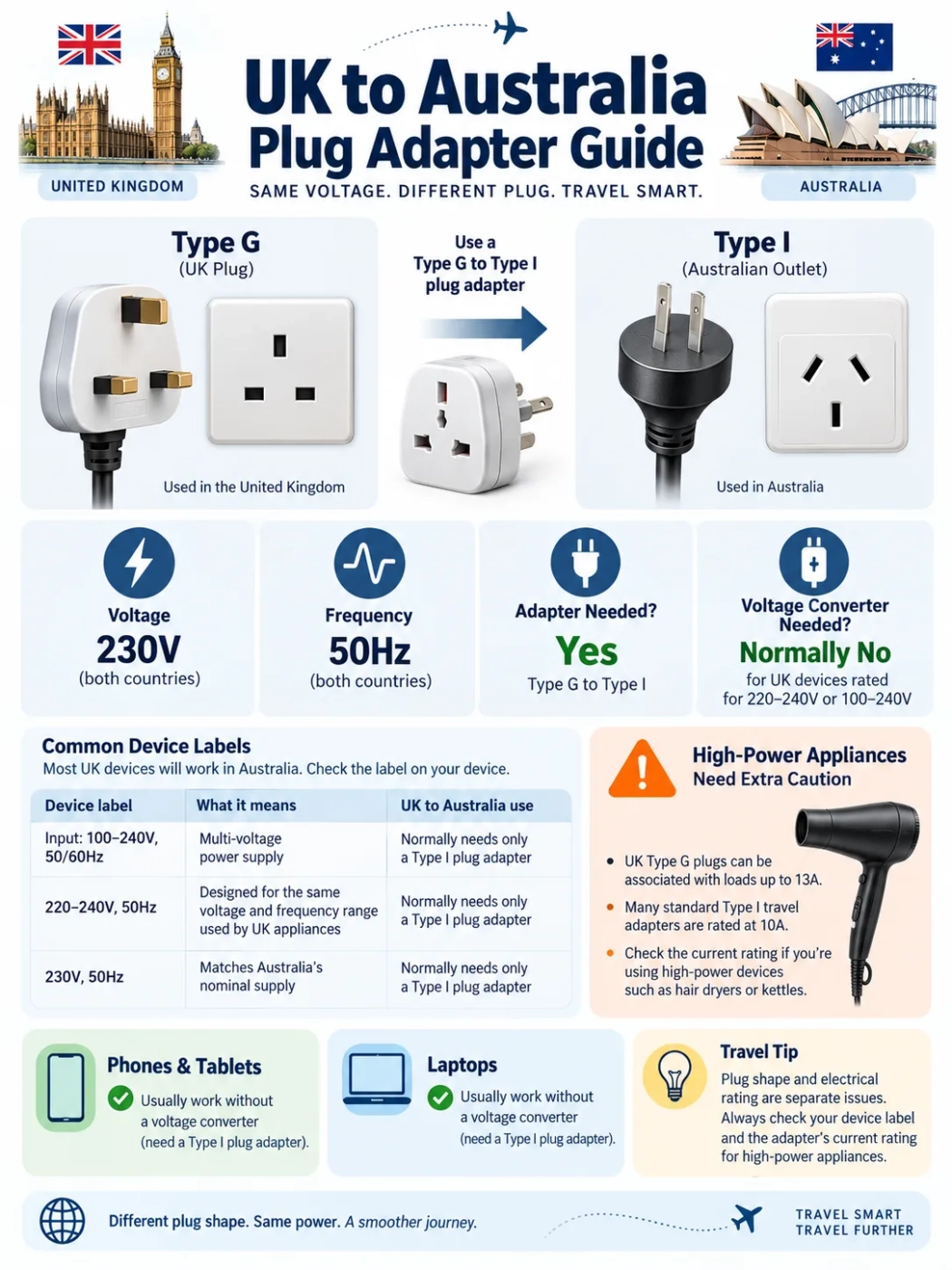
Traveling from the UK to Australia normally requires a Type G-to-Type I plug adapter. The good news is that both countries use a nominal 230V supply at 50Hz, so most UK electrical devices do not need a voltage converter. The main issue is the different plug shape. High-power UK appliances need an extra check because a typical Australian Type I travel adapter may have a lower current rating than a UK 13A plug.
| Item | United Kingdom | Australia |
|---|---|---|
| Common plug type | Type G | Type I |
| Standard voltage | 230V | 230V |
| Frequency | 50Hz | 50Hz |
| Plug adapter | Usually required: Type G to Type I | |
| Voltage converter | Normally not needed for UK devices rated for 220–240V or 100–240V | |
| Extra check | Type G plugs can be associated with loads up to 13A | Many standard Type I travel adapters are rated at 10A |
UK Type G to Australian Type I: The Physical Change
A British Type G plug has three rectangular pins. Australian Type I outlets use two angled flat slots and, on grounded connections, a vertical grounding slot. A UK Type G plug therefore does not fit directly into a normal Australian wall outlet.
Real outlet and adapter designs can look slightly different. The important point is that the adapter must accept the UK plug and present a Type I plug to the Australian outlet. Plug shape and electrical rating are separate issues.
Why a Voltage Converter Is Usually Unnecessary
The UK and Australia both use nominal 230V electricity at 50Hz. That makes this route simpler than travel between countries using 120V and 230V systems.
A UK device marked with an input such as 220–240V, 50Hz is normally suited to the Australian supply. A charger marked Input: 100–240V, 50/60Hz can accept an even wider range and will normally work without voltage conversion.
| Device label | What it means | UK to Australia use |
|---|---|---|
| Input: 100–240V, 50/60Hz | Multi-voltage power supply | Normally needs only a Type I plug adapter |
| 220–240V, 50Hz | Designed for the same voltage and frequency range used by UK appliances | Normally needs only a Type I plug adapter |
| 230V, 50Hz | Matches Australia’s nominal voltage and frequency | Normally needs only a Type I plug adapter |
| 110–120V only | Not designed for a 230V supply | Do not connect with only a plug adapter |
| No readable electrical rating | Compatibility cannot be confirmed from the device | Check the manual or manufacturer information before use |
A plug adapter does not convert voltage. It only changes the physical connection between the UK plug and the Australian socket. The similar electrical systems of the UK and Australia are the reason a converter is usually unnecessary, not anything the adapter does electrically.
The 13A UK Plug and 10A Australian Adapter Difference
Matching voltage does not mean every UK appliance should be connected through every Australian travel adapter.
The UK Type G system uses 13A plugs and sockets. Standard Australian general-purpose Type I plugs are commonly 10A, and many travel adapters sold for Australian outlets are also marked 10A maximum. Higher-current Australian plug configurations exist, but they are not what a traveler should assume is available from an ordinary hotel or household outlet.
This matters most with powerful heating appliances. A UK appliance can be fully compatible with 230V and 50Hz yet still draw more current than a particular travel adapter is designed to carry.
Estimating Current from Appliance Wattage
For a simple estimate on a 230V supply:
Current in amps ≈ appliance watts ÷ 230
| Example load | Approximate current | What it means for a 10A adapter |
|---|---|---|
| 65W laptop charger | 0.28A | Far below 10A |
| 100W USB-C charger | 0.43A | Far below 10A |
| 1,500W appliance | 6.5A | Below 10A, but the adapter rating still needs checking |
| 2,000W hair dryer | 8.7A | Close enough to the limit that the adapter’s marked rating matters |
| 2,300W appliance | 10A | At approximately the 10A level |
| 2,400W appliance | 10.4A | Above 10A at 230V |
| 3,000W UK kettle | About 13A | Not suitable for a 10A travel adapter |
These values are estimates. Use the appliance nameplate and the adapter’s own rating as the deciding information. Never exceed the maximum current or wattage printed on the travel adapter.
A UK plug having a 13A fuse does not increase the capacity of a 10A travel adapter. The lowest-rated component in the connection remains the limiting part.
Why a 3,000W UK Kettle Is a Special Case
High-powered kettles are one of the clearest examples of why UK-to-Australia compatibility cannot be judged from voltage alone.
A 3,000W kettle operating around 230V draws roughly 13A. Electrically, its voltage and frequency may match the Australian supply perfectly. Physically, a Type G-to-Type I adapter could also allow the plug to connect. A travel adapter rated at only 10A, however, is not suitable for that load.
Do not use a 3kW UK kettle through a 10A travel adapter. Voltage conversion would not solve this problem because voltage is not the mismatch. The issue is the current rating of the connection.
For high-powered kettles and similar appliances, using equipment intended for the local Australian outlet system is generally a simpler option than trying to reproduce a UK 13A connection through a compact travel adapter.
Hair Dryers, Straighteners and Other Heat-Producing Appliances
UK hair appliances have an advantage over 120V-only appliances brought from countries such as the United States: most are already intended for a 220–240V supply. That does not automatically make every one suitable for a travel adapter.
A 1,600W hair dryer draws roughly 7A at 230V. A 2,000W model draws about 8.7A. A 2,400W model is around 10.4A. The last example can exceed a 10A adapter even though the appliance itself is perfectly comfortable with Australian voltage.
Before using a hair dryer, curling iron, straightener, clothes iron, steamer or other heating appliance, check:
- the appliance input voltage;
- the frequency requirement;
- the appliance wattage or current;
- the maximum current or wattage printed on the adapter;
- whether the appliance requires an earth connection.
High-power appliances should never be judged only by whether the plug physically fits.
Phones, USB-C Chargers and Laptops from the UK
Phones, tablets, cameras and laptops are normally much simpler because their power supplies use relatively little current and many are designed for international mains voltages.
Phone and USB Chargers
Check the small print on the wall charger rather than the phone itself. A charger marked Input: 100–240V, 50/60Hz can normally operate from an Australian 230V, 50Hz outlet. The UK Type G plug still needs to be adapted to Type I.
The USB cable does not determine mains voltage compatibility. The electrical input rating belongs to the wall charger or power supply.
Laptop Chargers
Many laptop power bricks also accept 100–240V and 50/60Hz. If yours does, a voltage converter is normally unnecessary.
Some laptop chargers have a removable mains cable. In that case, a compatible Australian Type I mains lead designed for that power supply can remove the need for a plug adapter altogether. The replacement lead must use the correct connector and electrical rating for the charger.
Cameras, Shavers and Toothbrush Chargers
Camera battery chargers are often multi-voltage, but the label should still be checked. Electric shavers and toothbrush charging bases vary more. A product that says only 230V/50Hz will normally match Australia electrically; a product with a wider 100–240V, 50/60Hz rating is also normally suitable.
Do not assume that every low-power bathroom device is multi-voltage simply because similar models are.
Grounding Matters with Three-Pin UK Equipment
A Type G plug includes an earth connection. If the appliance depends on protective earthing, the travel adapter should preserve that earth connection through to the Australian Type I outlet.
Some travel adapters accept a three-pin plug physically but are intended only for double-insulated equipment and do not provide a usable earth path. That is not an equivalent connection for grounded equipment.
Check the adapter description and markings rather than assuming that three visible openings mean all three conductors are connected. A physical fit does not guarantee grounding continuity.
Double-insulated equipment is different. It normally carries the Class II symbol of one square inside another and does not rely on a protective earth conductor. Follow the appliance instructions if there is any uncertainty.
Using a UK Extension Lead in Australia
Connecting several UK devices to one UK extension lead and then placing a single Type I adapter at the wall can create a misleading sense that the full UK 13A capacity is available.
The total load of everything connected to the extension lead passes through that one travel adapter. If the adapter is rated at 10A, the combined load must remain within the adapter’s marked rating regardless of what the UK extension lead itself can handle.
A few low-power chargers may draw very little current, but combinations involving kettles, hair dryers, irons or heaters can exceed a travel adapter’s limit quickly.
Avoid stacking travel adapters, connecting one adapter into another, or using improvised arrangements to reach more sockets. For several phones and tablets, a suitable multi-port charger can reduce the number of mains connections needed without adding a chain of adapters.
Australian Wall Outlets and Their Switches
Many Australian wall outlets have a separate switch beside the Type I socket. UK travelers will find this familiar because switched outlets are also common in the UK, although the Australian socket shape is different.
If a socket has a switch, make sure the plug and adapter are seated properly and use the switch normally. A switched outlet does not change the voltage or increase the adapter’s allowable load.
Hotels may sometimes provide USB charging ports or multi-standard sockets, but these should not be assumed to be available. Do not assume that a universal-looking hotel socket changes the voltage.
Choosing a UK-to-Australia Travel Adapter
For this route, the adapter should be designed to accept a UK Type G plug and connect to an Australian Type I outlet.
Check the following markings and features before relying on it:
- Type I output plug for use in Australian outlets;
- a socket designed to accept a UK Type G plug;
- a clear maximum current or wattage rating;
- ground continuity if the connected appliance requires earthing;
- secure construction with no loose or damaged pins;
- an electrical rating suitable for the device being connected.
Travel adapters are intended for temporary travel use rather than permanent electrical conversion.
If purchasing a travel adapter in Australia, look for appropriate Australian compliance marking such as the RCM. If purchasing before departure in the UK, use a properly marked travel adapter from a reputable seller and check that it is intended for a UK plug/socket section and Australian Type I connection.
Device Compatibility from the UK to Australia
| UK device | Type I adapter? | Voltage converter? | Main check |
|---|---|---|---|
| Phone charger | Yes, with a UK Type G plug | Normally no if rated 100–240V or 220–240V | Input label |
| USB-C charger | Yes, unless using a Type I mains connection | Normally no if multi-voltage | AC input rating, not USB output rating |
| Laptop charger | Usually | Normally no if rated 100–240V | Power-brick input and removable mains lead options |
| Camera battery charger | Usually | Normally no if multi-voltage | Charger input label |
| Electric toothbrush | Usually | Depends on charging base | Voltage and frequency printed on charger |
| Electric shaver | Usually | Depends on model | Voltage, frequency and insulation type |
| Hair straightener | Yes | Normally no for a UK 220–240V model | Wattage and adapter rating |
| Hair dryer | Yes | Normally no for a UK 220–240V model | High wattage and adapter current limit |
| 3,000W kettle | A physical adapter is not enough | No voltage conversion issue | Approximately 13A draw is above a 10A adapter rating |
| CPAP machine | Usually, if supplied with a Type G plug | Depends on its power supply | Power-supply label and manufacturer instructions |
CPAP Machines and Other Essential Electrical Equipment
For a CPAP machine or other medical device, check the original power supply rather than assuming normal consumer-electronics rules apply. Many external medical power supplies accept 100–240V, 50/60Hz, but compatibility depends on the exact equipment.
If the power supply accepts Australia’s 230V and 50Hz, the remaining requirement may simply be a suitable Type I connection. Also check whether the equipment requires grounding, whether a humidifier changes the power requirement, and what the manufacturer specifies for travel use.
Do not rely on an unknown hotel USB port, shaver socket or unverified universal adapter for equipment that must remain available overnight.
Common UK-to-Australia Plug Mistakes
Assuming 230V Means Every UK Appliance Is Automatically Safe
The matching voltage and frequency solve one part of the problem. High-current appliances can still exceed the rating of the travel adapter.
Treating a 13A UK Plug as a 13A Australian Connection
A fused Type G plug can be part of a 13A UK connection, but a Type I travel adapter may be rated at only 10A. The adapter does not inherit the higher UK rating.
Using a Grounded Appliance Through an Ungrounded Adapter
An adapter that accepts the shape of a three-pin Type G plug is not automatically suitable for appliances that rely on protective earthing.
Looking Only at the Voltage Printed on a Universal Adapter
A marking such as 250V does not mean the adapter can carry any appliance used at that voltage. Current and wattage limits must also be respected.
Adding Several Appliances Through One Adapter
The currents from devices connected through an extension lead or multi-socket arrangement add together. The travel adapter’s maximum rating still applies to the total load.
What to Pack for a UK to Australia Trip
- A Type G-to-Type I travel adapter for devices with fixed UK plugs.
- A grounded adapter if any appliance requires a protective earth connection.
- Chargers whose labels have already been checked for Australian 230V, 50Hz power.
- A suitable Australian mains lead instead of an adapter when a laptop or charger safely supports a removable country-specific lead.
- Separate planning for high-power appliances rather than assuming one small adapter will handle them.
- Manufacturer power information for CPAP machines or other essential equipment.
For ordinary phone, tablet and laptop charging, the Type G-to-Type I plug change is normally the only adjustment needed. High-powered UK appliances deserve a separate decision because their current draw can be more important than the voltage difference—which, on this route, is effectively not a difference at all.
FAQ
Do I need a plug adapter from the UK to Australia?
Yes. UK Type G plugs do not fit normal Australian Type I outlets, so a Type G-to-Type I adapter is usually required.
Do I need a voltage converter from the UK to Australia?
Usually not. Both countries use nominal 230V electricity at 50Hz. Check the device label; UK equipment marked 220–240V or chargers marked Input: 100–240V are normally compatible with Australia’s supply.
Can I use my UK phone or laptop charger in Australia?
Usually yes if the charger accepts 230V. Most modern chargers marked 100–240V, 50/60Hz need only the correct Type I plug adapter.
Can I use a UK 3,000W kettle in Australia?
Not through a typical 10A travel adapter. A 3,000W appliance draws about 13A at 230V, which is above a 10A adapter rating even though the voltage and frequency are compatible.
Can I use a UK hair dryer in Australia?
Often, but check its wattage as well as its voltage. A UK hair dryer may already be compatible with 230V, while a powerful 2,400W model can draw more than 10A and may exceed the rating of a standard travel adapter.
Does a three-pin UK plug need a grounded adapter in Australia?
If the appliance relies on protective earthing, yes. Use an adapter that preserves the earth connection to the Australian Type I outlet rather than one that merely accepts the physical shape of a three-pin plug.